Disclaimer: This article is intended for information and educational use only. It does not replace the medical diagnosis of a Doctor. Please seek the advice of a competent medical practitioner on all issues concerning your health.
Key Points
✓ Up to 1 in 5 patients report dissatisfaction after primary total hip replacement.
✓ The risks of hip replacement surgery involve: infection around the prosthesis, dislocation, loosening of the prosthesis without infection, limb length inequality, and cobalt-chromium metal particles in the blood stream.
✓ Mortality following periprosthetic infection of the hip is equivalent to 5-year mortality from commonly occurring cancers.
✓ A significant percentage of opioid-naïve hip patients continue filling opioid prescriptions long after surgery.
✓ FDA-approved, ultra minimally invasive alternative Deuk Plasma Rhizotomy® (DPR). Targets only the painful nerve fibers of the hip joint. No joint involvement.
✓ Outpatient procedure completed in roughly 30 minutes through a 4mm incision. No general anesthesia, no implant, no opioids.
✓ Average pain reduction of 85%, allowing most people to return to normal light activity the very next day.
✓ You keep your natural hip and you remain a full candidate for hip replacement at any point in the future if you ever need it.
Hundreds of thousands of Americans who are experiencing chronic hip pain hear the same message every year, which is that at some point in your life, you are going to need a total hip replacement surgery. THA or Total Hip Arthroplasty is one of the most common operations performed in the country, and its future demand seems to keep rising. Yet the procedure comes with a considerable amount of risk. ¹
For the millions living with chronic hip pain from osteoarthritis, avascular necrosis, or degenerative joint disease, the idea of having your natural joint cut out and replaced with metal, ceramic, and plastic hardware is daunting and for good reason. What if there were a way to eliminate the pain without eliminating the hip?

Here is an FDA-approved, minimally invasive technique for the relief of hip joint arthritis pain. The procedure is known as Deuk Plasma Rhizotomy® and is a breakthrough in chronic hip pain management techniques.
What Is Deuk Plasma Rhizotomy® for the Hip?
Deuk Plasma Rhizotomy® is a patented technique invented by neurosurgeon Dr. Ara Deukmedjian, in which the precise sensory nerves that transmit pain from an arthritic hip joint are ablated using a plasma wand. The wand is passed through a single 4mm incision to target those pain pathways. Without any surgical intervention on the joint itself.
Unlike conventional heat-based radiofrequency ablation, DPR uses lower-temperature plasma energy to treat the targeted nerve tissues while sparing the surrounding joint structures. The natural anatomy and full range of motion of the hip are preserved. No implantation, no removal. The only thing that changes is the pain.
The Problem with Hip Replacement Surgery
Hip replacement surgery is the surgical removal of the damaged femoral head. Followed by the excavation of the acetabulum to accommodate the artificial joint that is usually made of metal and plastic. The procedure involves an incision that is between four and ten inches long, general or spinal anesthesia, and a hospital stay. Recovery is often more difficult than expected.
Patient satisfaction after hip replacement is often reported as excellent, but the honest peer-reviewed picture is more complicated. Published narrative reviews report a dissatisfaction rate after primary THA of roughly 7% to 20%, ² and a systematic review with proportional meta-analysis found pooled dissatisfaction rates of 10%, 4%, and 7% at short-, mid-, and long-term follow-up. ³ A separate best-evidence synthesis in EFORT Open Reviews concluded that up to 28% of hip and knee arthroplasty patients report some degree of dissatisfaction with their outcome. ⁴ For patients considering an irreversible operation, those numbers are not trivial.
Complications of Hip Replacement Most Patients Aren’t Told About
Orthopedic surgeons often present hip replacement as a routine, safe procedure. The peer-reviewed literature paints a more complex picture. Several well-documented complications deserve careful consideration before consenting to surgery.
Periprosthetic Joint Infection (PJI)
Infection remains one of the most dreaded complications after undergoing hip replacement surgery. Infection rate following primary total hip arthroplasty has been reported to be anywhere between 0.5 and 2.3 percent. ⁵ Although the above figure might look relatively low, when taken into account the number of hip replacements done every year, it is a significant number.
Death following hip PJI is the data that patients are never shown. According to a systematic review from 2019 of over 19,000 patients, 1-year mortality was found to be 4.22%, and 5-year mortality rate was 21.12% following 2-stage revision of hip PJI, which is 3.58 times greater than the mortality risk among the national average after age adjustment. ⁶ In another recent meta-analysis conducted in 2025 and published in the journal The Journal of Arthroplasty, it is noted that mortality after PJI following THA will become 11% within 3 years, which is equivalent to the 5-year mortality rate among common cancers like breast cancer. ⁷ Treating PJI involves many other surgeries, IV antibiotics, prolonged hospital stay, and even hardware removal in some cases.
Dislocation of the Prosthetic Hip
Dislocation is the second most prevalent complication following THA. ⁸ Registry data from the UK’s National Joint Registry rank dislocation or subluxation as the single most common reason for revision within the first year after primary hip replacement. ⁹ Once a hip has dislocated, the risk of recurrent instability rises, and recurrent instability frequently drives yet another operation.
Aseptic Loosening of the Implant
Aseptic loosening is a progressive weakening of the fixation of the prosthesis within the bone. The most frequent long-term reason for the failure of hip implants. Caused by inflammation of the body due to the small wear particles of the prosthetic parts, leading to the destruction of the bone around the hip implant through the process known as osteolysis. ⁹ Current data of more than 215,000 hips from a registry indicate 89% of hips to be surviving after 15 years and only 58% after 25 years. ¹⁰ At the age of 55, this indicates a high probability of undergoing one or even several operations for revision.
Metal Fragments and Cobalt-Chromium Toxicity (Metallosis)
When the metal, ceramic, and plastic parts of the artificial hip joint rub against each other year after year, very fine particles are shed into the surrounding tissues and sometimes into the blood stream. This phenomenon is referred to as metallosis and leads to bone loss, pseudotumors, and ultimately to revision surgeries.
There is mounting evidence that systemic toxicity caused by the exposure to cobalt and chromium ions from the hip implants occurs in many cases. Not only metal on metal devices, but also other bearing surfaces are sometimes involved. A systematic review published in Clinical Toxicology identified reported cases of neuro-ocular toxicity, cardiotoxicity, and thyroid dysfunction attributed to cobalt released from hip prostheses, with symptoms including peripheral neuropathy, sensorineural hearing loss, cognitive decline, visual impairment, and cardiomyopathy. Some of which appeared years after implantation. ¹¹ Fatal cobalt-related cardiomyopathy has been reported even in patients whose implants were not metal-on-metal. ¹²
Leg Length Discrepancy
Leg length discrepancy (LLD) after hip replacement is one of the most common complications patients are rarely warned about before surgery. A recent review reported that LLD occurs in 3% to 30% of THA cases, with mean discrepancies ranging from 3 to 17 mm. ¹³ Even relatively small differences can produce a limp, chronic low-back pain, gait disturbance, and reduced patient satisfaction and LLD is one of the leading sources of medico-legal claims against orthopedic surgeons in the United States. ¹³ ¹⁴
The Pain Medication Cycle: Why More Surgery Isn’t the Answer
In the typical case of people suffering from hip arthritis, the course to joint replacement surgery generally includes several steps, which include the use of over-the-counter painkillers, followed by prescription NSAIDs, cortisone injections, and opioid drugs.

However, surgery itself marks the start of yet another opioid cycle. Data obtained from the population-based study of Danish Hip Arthroplasty Register involving more than 80,000 primary THAs demonstrated that of patients with one or more opioid prescriptions during the first month post-surgery, 21% to 28% of those naïve to opioids received further opioid prescriptions within 1 and 12 months postoperatively. The rate increased to over 60% in patients using opioids before their surgery. ¹⁵ The registry cohort of more than 40,000 primary hip arthroplasties found that 2.2% to 4.6% of patients without a history of opioid use qualified for new chronic use of opioids 1 year after surgery. ¹⁶ When the first hip replacement fails due to infection, loosening, dislocation, or pain, the treatment strategy becomes yet another hip replacement, which is technically more difficult, more painful, and has higher risks of complications compared to the original procedure.
It is a cycle of escalation: pain medications, then surgery, then more pain medications, and sometimes more surgery. Deuk Plasma Rhizotomy® offers a way to step off that escalator entirely.
How Deuk Plasma Rhizotomy® Works for Hip Pain
DPR is built on a fundamentally different philosophy than hip replacement. Rather than removing the natural joint and installing an artificial one, DPR eliminates the pain at its neurological source.
Here is what the process looks like from a patient’s perspective:
Step 1: Free Consultation and Diagnosis. The process begins with a no-cost review of your existing hip MRI. Dr. Deukmedjian and his team identify the specific sensory nerves. Including branches of the obturator and femoral nerves. That carries pain signals from the arthritic hip joint to the brain, and confirms whether you are a candidate. No office visit is required to begin.
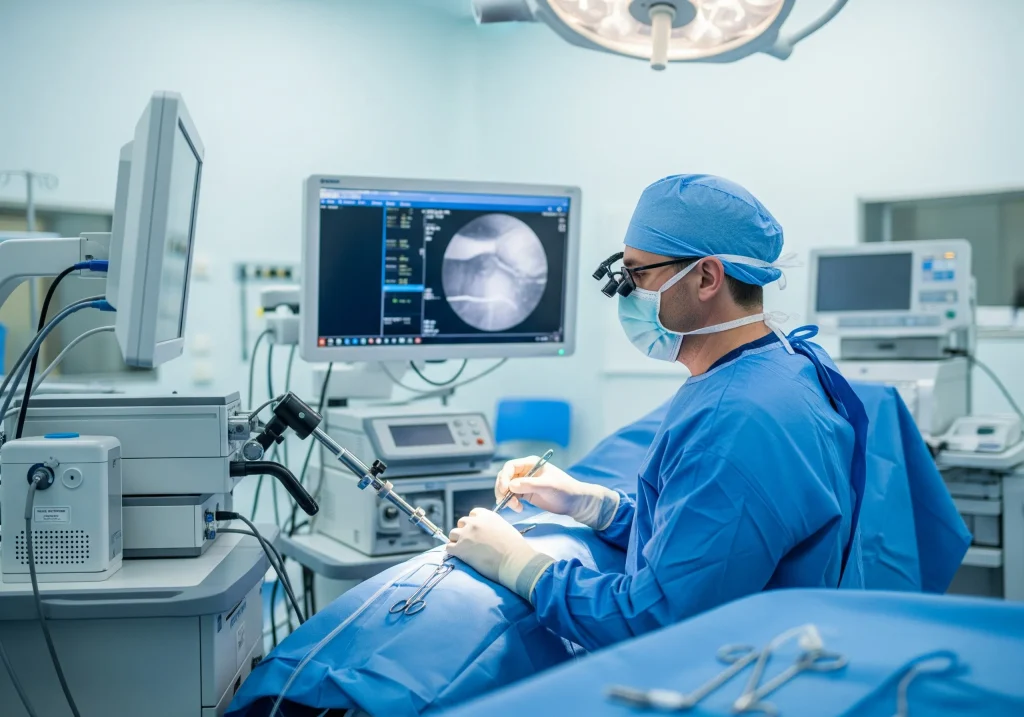
Step 2: The 30-Minute Procedure. Under light twilight sedation and not general anesthesia. Dr. Deukmedjian makes a single 4mm opening (smaller than a pencil eraser) and inserts the patented plasma wand. Using precision plasma energy, the targeted pain-carrying nerves are ablated while the surrounding joint tissue and structure remain untouched. The incision is closed with a single staple and covered with a Band-Aid.
Step 3: Home the Same Day. Patients leave the facility within about an hour of the procedure. There is no hospital stay, no general anesthesia, and no opioid prescription. Most patients return to normal light activity the very next day.
Because DPR destroys only the pain nerves and leaves the joint completely intact, there is nothing to dislocate, nothing to loosen, no metal to shed debris, no foreign material to become infected, and no prescription narcotics required for recovery. Your natural hip stays exactly where it is.
Deuk Plasma Rhizotomy® vs. Total Hip Replacement: A Side-by-Side Comparison
The contrast between these two approaches is significant across nearly every dimension that matters to a patient.
Who Is a Candidate for Deuk Plasma Rhizotomy® of the Hip?
You may qualify for DPR of the hip if:
- A surgeon has recommended total hip replacement, but you would like to explore an alternative first.
- You suffer from chronic hip pain caused by osteoarthritis, avascular necrosis, or degenerative joint disease that has not responded adequately to medications, injections, or physical therapy.
- You want to avoid the hardware, hospitalization, and prolonged rehabilitation associated with THA.
- You have already undergone a hip replacement that did not fully resolve your pain.
The fastest way to determine whether this ultra minimally invasive treatment is right for you is a free MRI review. And if DPR is not a fit for your case, you remain a full candidate for hip replacement surgery.
The Bottom Line
Hip arthroplasty is a significant surgery with known dangers including infections around the prosthesis with increased mortality in the long run, dislocation, aseptic loosening, cobalt-chromium wear with possible systemic effects, limb length discrepancy, postoperative pain, and prolonged opioid usage. This risk can be avoided by most individuals.
Deuk Plasma Rhizotomy® is a fundamentally different solution. It does not address the hip joint itself; it addresses the pain. The procedure takes about 30 minutes on an outpatient basis, through a 4mm incision, under twilight sedation. There is no implant, no hospitalization, no general anesthesia, and no opioids. Average pain reduction is approximately 85%.
At Deuk Joint, the emphasis is not on replacing your joint but on saving it. DPR was created by Dr. Ara Deukmedjian, a board-certified neurosurgeon with more than 20 years of experience, because he believed patients deserved a better option than removing their own natural joint. If you or someone you love suffers from chronic hip pain and has been told that replacement is the only cure. There may be another way.
Keep Your Hip.
Lose the Pain.
Deuk Plasma Rhizotomy® eliminates chronic hip pain at the nerve — not the joint. A 30-minute outpatient procedure with no implant, no general anesthesia, and no opioids.
FAQ
What is Deuk Plasma Rhizotomy® for the hip?
Answer
Deuk Plasma Rhizotomy is a patented, minimally invasive same-day procedure that uses precise plasma energy to ablate the specific sensory nerves that carry pain signals from the arthritic hip joint. Invented by neurosurgeon Dr. Ara Deukmedjian, it treats the underlying source of hip pain without removing or replacing the hip. The procedure is performed through a single 4mm incision under twilight sedation and typically takes about 30 minutes.
Is Deuk Plasma Rhizotomy FDA approved?
Answer
Yes. DPR uses FDA-approved plasma technology to ablate the pain-carrying nerves around the hip joint. The procedure is performed using a patented plasma wand that has been cleared for clinical use.
How long does the pain relief last?
Answer
Results are typically long-lasting. In some cases, patients may experience soreness in surrounding muscles (bursitis or tendonitis) as they return to higher levels of activity, which can feel similar to the original hip pain but originates from a different source. In select cases, the procedure can be repeated if needed.
Will I be under general anesthesia?
Answer
No. DPR is performed under light twilight sedation and not general anesthesia. This is one of the reasons recovery is so fast. You are relaxed and comfortable during the procedure but are not put fully under.
How is DPR different from radiofrequency ablation (RFA) of the hip?
Answer
Traditional radiofrequency ablation uses heat to damage nerve tissue, which can affect a broader area and cause collateral damage to surrounding structures. Deuk Plasma Rhizotomy uses plasma energy at a lower temperature, allowing more precise targeting of the specific pain-carrying nerves around the hip while preserving the joint and surrounding tissue.
Can I still get a hip replacement later if I need one?
Answer
Absolutely. Because DPR does not remove, alter, or implant anything in your hip joint, you remain a full candidate for total hip replacement in the future if it becomes necessary. Trying a less invasive option first carries no downside.
What if my hip replacement already failed. Can I still be treated?
Answer
Often, yes. Because DPR targets the pain nerves rather than the joint structure or implant, many patients with a painful or partially failed hip replacement remain candidates. A free MRI review can confirm whether the procedure is appropriate for your specific situation.
How do I find out if I am a candidate?
Answer
The simplest first step is a free MRI review. Send your recent hip MRI or CT report to the team at Deuk Joint, and Dr. Deukmedjian will personally review it at no cost to determine whether Deuk Plasma Rhizotomy can relieve your hip pain.
Sources
View Sources
- Learmonth, I.D., Young, C., Rorabeck, C. (2007). The operation of the century: total hip replacement. The Lancet, 370(9597), 1508–1519. View source
- Shao, Z., Bi, S. (2023). Patient satisfaction after total hip arthroplasty: influencing factors. Frontiers in Surgery, 9:1043508. PMC9922864
- Chang, C.B. et al. (2024). What percentage of patients are dissatisfied post-primary total hip and total knee arthroplasty? The Journal of Arthroplasty. View source
- Kahlenberg, C.A. et al. (2020). Do dissatisfied patients have unrealistic expectations? A systematic review in knee and hip arthroplasty. EFORT Open Reviews, 5(4), 226–240. View source
- Alrayes, M.M. et al. (2024). Periprosthetic joint infection: a multifaceted burden undermining arthroplasty success. PMC12187470
- Natsuhara, K.M. et al. (2019). Mortality during total hip periprosthetic joint infection. The Journal of Arthroplasty, 34(7S), S337–S342. PubMed 30642705
- Deckey, D.G. et al. (2025). Periprosthetic joint infection mortality after total hip arthroplasty is comparable to 5-year rates of common cancers: a meta-analysis. The Journal of Arthroplasty. View source
- Fu, Y. et al. (2024). Limb length, offset, and dislocation after total hip arthroplasty. Frontiers in Surgery. PMC11177783
- Deere, K. et al. (2022). How long do revised and multiply revised hip replacements last? A retrospective observational study of the National Joint Registry. The Lancet Rheumatology. View source
- Evans, J.T. et al. (2019). How long does a hip replacement last? A systematic review and meta-analysis of case series and national registry reports with more than 15 years of follow-up. The Lancet, 393(10172), 647–654. View source
- Bradberry, S.M., Wilkinson, J.M., Ferner, R.E. (2014). Systemic toxicity related to metal hip prostheses. Clinical Toxicology, 52(8), 837–847. PubMed 25132471
- Peters, R.M. et al. (2017). Fatal cobalt toxicity after a non-metal-on-metal total hip arthroplasty. Case Reports in Orthopedics. PMC5591987
- Marra, F. et al. (2025). Leg length discrepancy after total hip arthroplasty: a review of clinical assessments, imaging diagnostics, and medico-legal implications. PMC12193556
- Konyves, A., Bannister, G.C. (2005). Influence of self-reported leg length discrepancy on function and satisfaction 6 years after total hip replacement. PMC3179609
- Kornvig, S. et al. (2024). Do sex, age, and comorbidities modify the association of socioeconomic status and opioid use after total hip arthroplasty? PMC11100492
- Kornvig, S. et al. (2025). Association of preoperative psychopharmacological treatment and the risk of new chronic opioid use after hip and knee arthroplasty. PMC12207537