
Dr. Ara J. Deukmedjian, MD
Board Certified Neurosurgeon
Published: October 7, 2026
Medical Disclaimer: Information and statements contained herein are for informational and educational purposes only and do not constitute a medical consultation, diagnosis or treatment recommendation. Consult a qualified medical practitioner regarding any questions with regards to your health.
Key Points
✓ Chronic ankle arthritis is usually driven by osteoarthritis, old sprains or fractures, or rheumatoid disease.
✓ Roughly 11.7% of older adults report ankle pain; 3.4% have symptomatic radiographic ankle OA. ¹
✓ Ankle arthritis cannot be cured. Once cartilage is lost, it doesn’t grow back. ²
✓ Ankle fusion nonunion rates reach 8.1% pooled, and up to 21.3% on CT imaging. ³, ⁴
✓ Ankle replacement has higher revision rates than hip or knee at 26.9% of revisions need further surgery, 14.4% fail. ⁵
✓ Persistent opioid use after foot and ankle surgery runs 2.6%–18.5%, up to 39% with prior use. ⁶
✓ Deuk Plasma Rhizotomy® targets only the pain nerves. No fusion, no implant, no replacement.
Taking that initial step out of bed. Going up a flight of stairs. Waiting in line at the grocery store. Turning your foot to roll it off a curb, then experiencing a sharp, grinding pain in your joint. That is how millions of Americans live each day dealing with arthritis pain in their ankles. Once conservative treatments such as bracing, medication, injection, and physical therapy no longer provide relief, there are only two surgical options: ankle fusion and ankle replacement.
But both operations are major procedures. With long recoveries, documented complications, and failure rates patients are rarely told about upfront. ³, ⁵
For anyone living with ankle arthritis from old sprains, years of wear and tear, or rheumatoid disease. The idea of having the natural ankle fused solid or carved out and replaced with metal and plastic hardware is unsettling. What if the pain could be eliminated without fusing or replacing your ankle?
That is exactly what Deuk Plasma Rhizotomy® was designed to do. It is a patented, ultra-minimally-invasive, FDA-cleared treatment for chronic ankle joint pain and it is changing how arthritis in the ankle is managed at every stage.
What Is Ankle Arthritis? What Does Arthritis in the Ankle Feel Like?
The condition of arthritis in the ankle is characterized by the degeneration of cartilage tissue covering the tibiotalar joint, which is where the tibia bone and ankle bone meet. Due to the degeneration of cartilage tissue, bones tend to come into contact with each other while in motion.

When people look for the description of arthritis in the ankle, they usually mention one of the following symptoms:
- A deep, dull ache inside the front or sides of the ankle that worsens with activity
- Morning stiffness that eases after a few minutes of walking, then returns later in the day
- A grinding, catching, or clicking sensation with each step
- Swelling around the ankle after standing, walking, or exercise
- Sharp, “catching” pain when the foot rolls or pivots
- A sense of instability. Feeling that the ankle might “give way”
Patients commonly search for swollen ankle arthritis pictures in an effort to match what they see on their own foot. The classic appearance includes a puffy, thickened joint line in front of the ankle, loss of the normal bony contours, and in advanced cases a visible bone spur or deformity.
An MRI remains the most reliable way to confirm the diagnosis, measure cartilage loss, and rule out other causes such as tendon tears or stress fractures. ²
Common Causes of Chronic Ankle Pain
Knowing why you have that pain is crucial, since you can’t treat something effectively until you understand where it’s coming from. The truth is that most of the pain associated with an ankle joint comes from:
- Ankle arthritis. Wear on the cartilage from friction between the tibia and talus results in grinding, stiffness, swelling, and deep ache pain during activities.
- Previous sprains and fractures. The previous history of sprains, injury to ligaments, or any fractures might lead to joint instability. Post traumatic arthritis is actually the most common type of end stage ankle arthritis in contrast to the hip and knee which are mostly affected by primary arthritis.
- Overuse and instability. Many years of high impact activity, constant running, or repetitive twisting of the ankle joint leads to joint wear. Mostly professional athletes, veterans, or people involved in physically demanding occupations.
- Rheumatoid arthritis of the ankle joint. This is an inflammatory condition affecting joints of autoimmune origin.
Can Rheumatoid Arthritis Be in Your Ankle?
Yes. And it is much more frequent than many patients can imagine. An ultrasound study at multiple centers involving 216 rheumatoid arthritis (RA) patients has shown ankle joint involvement in 87% of patients, in contrast to only 28.5% of healthy controls. ⁷ Another cross-sectional study of over 2,000 RA patients has identified the ankle joint as the most frequently involved one among those with foot and ankle arthritis. Inflamed in 71.4%, and swollen in 59.5%. ⁸

When rheumatoid arthritis affects the ankles, it usually involves both ankles, causes stiffness that lasts for hours in the morning, and causes swelling in the joint and tendons. The failure to treat RA may result in severe damage to the ankle joint and tendons. This is why early diagnosis and treatment of RA with DMARD is so important.
Ankle Arthritis Symptoms That Point to the Joint
Problems arising from muscles and tendons in the ankle joint are generally alleviated with rest, treated by stretching and anti-inflammatory medicines, and heal in a few days’ time. But problems resulting from joint issues such as arthritis generally do the exact opposite. These problems are aggravated with movement, become sore following long periods of standing, and do not heal with ice or heat treatment.
The classic ankle arthritis symptoms that point to the joint itself include:
- Deep pain inside the ankle rather than around the tendons
- Grinding, catching, or crepitus with motion
- Swelling that lingers for hours after activity
- Visible deformity or loss of range of motion
- Pain that disturbs sleep
Grinding, catching, weakness, and pain that doesn’t resolve with rest all point toward the joint itself. An MRI is the fastest way to know for sure.
Can Ankle Arthritis Be Cured?
Truthfully: No. Once the cartilage in the ankle joint is gone, it will never return. Those looking for “can ankle arthritis be cured?” deserve the truth rather than hype. ²
The aim of treatment should not be cure, but pain relief, functionality retention, and not having to substitute one problem with another. In the vast majority of cases, this would mean starting out with conservative treatments:
- Activity modification and weight management
- Supportive bracing or stiff-soled footwear
- NSAIDs or short courses of prescription anti-inflammatories
- Corticosteroid or hyaluronic acid injections
- Physical therapy focused on ankle stability
When those stop working, as they usually do eventually. The conversation historically shifts to ankle fusion or ankle replacement surgery. Both of which are irreversible and come with their own set of risks.
Living With Ankle Arthritis: Why the Standard Treatments Often Fail
Ankle arthritis sufferers almost always go through an identical and predictable journey, from over-the-counter anti-inflammatories to prescription NSAIDs to bracing to cortisone shots to physical therapy. And if that doesn’t work, the next step is surgery, but that’s only after everything else fails. The trouble is that each step in this ladder merely treats the symptoms of the problem without targeting the pain signal itself. There is a cost to every step on this ladder. From GI bleeds from NSAIDs to muscle wasting from braces, cartilage effects from cortisone, and addiction from opioids.
The Problem With Ankle Fusion Surgery
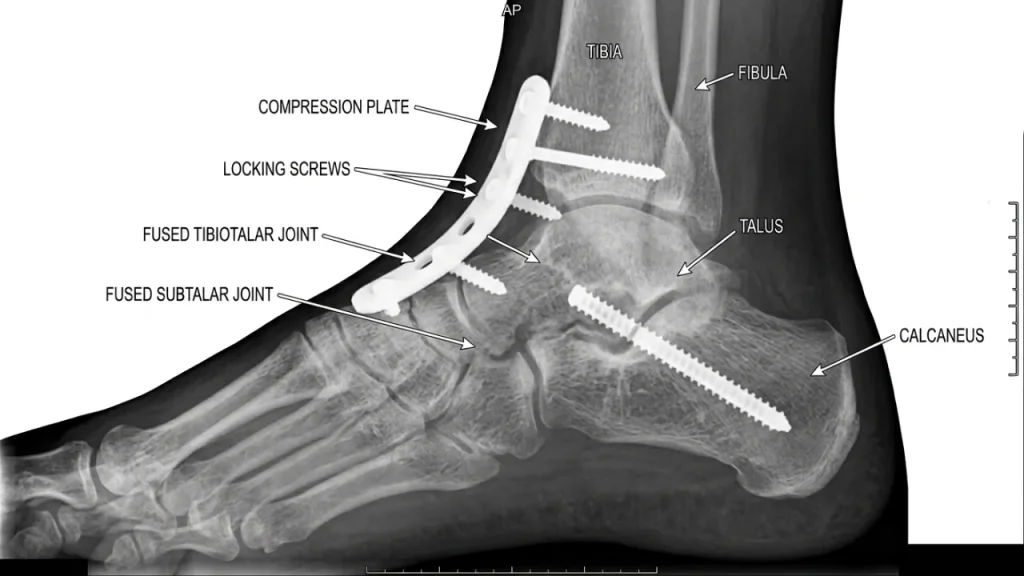
Fusion of the ankle joint. Otherwise known as ankle arthrodesis is a surgical procedure where cartilage tissues are removed from the body and then fusing together the tibia and talus bones with the help of screws, plates, and rods. In order to immobilize the joint. This surgery is carried out through a surgical incision of 3-5 inches and is done under general anesthesia. Recovery time is between 1-4 days in the hospital.
The research on the success of the procedure is disheartening.
Nonunion: When the Bones Don’t Actually Fuse
The whole purpose of ankle fusion is for the two bones to grow into one piece. If they fail to do so, then the surgery has been unsuccessful, and the patient ends up swapping one problem for another – a painful arthritic ankle for one that does not fuse and is also painful. An umbrella systematic review and meta-analysis of 14 systematic reviews on foot and ankle arthrodesis showed an overall pooled nonunion rate of 8.1%. ³ Another study, which used CT to confirm the fusion status of arthrodesis, found the actual nonunion rate to be 21.3%. Much higher than in previous radiographic studies. ⁴ Smokers have three times this risk. ³
Adjacent Joint Arthritis: Trading One Problem for Another
Fusing the ankle eliminates motion at the tibiotalar joint. But the demand for motion doesn’t disappear. It is transferred to the surrounding joints of the foot (the subtalar, talonavicular, and midfoot joints), which were never designed to compensate for a locked ankle. Over years, those neighboring joints begin to wear out from the extra load.
A 20-year follow-up study of ankle fusion patients published in the Journal of Bone & Joint Surgery (Br) documented significant long-term deficits in physical function and bodily pain on the SF-36 health survey, along with radiographic progression of arthritis in the adjoining joints. ⁹ A review of long-term ankle arthrodesis literature confirms adjacent joint arthritis as a recognized complication, often requiring additional surgery years down the road. ¹⁰
Permanent Loss of Natural Motion
Even when the fusion heals perfectly, the ankle is now permanently stiff. Patients cannot flex the foot up or down at the ankle. They adapt. But stairs, hills, running, kneeling, uneven terrain, and even simply bending to tie a shoe become permanently more difficult.
The Problem With Ankle Joint Replacement Surgery
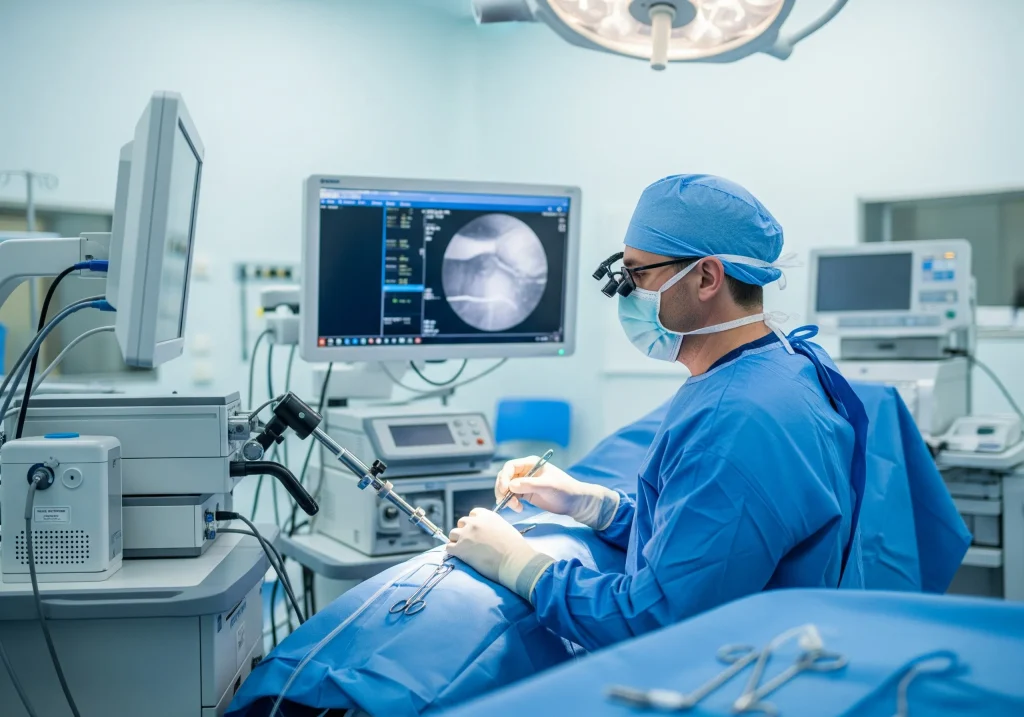
Ankle joint replacement surgery. Also known as total ankle arthroplasty or TAR. Is an attempt to preserve mobility through the removal of the damaged joint surfaces and implanting new metal and plastic surfaces. However, when we look at the results that have been published, the story is not that simple.
Higher Revision Rates Than Hip or Knee Replacement
Revision rates for ankle arthroplasties are, as one systematic review bluntly put it, “higher than hip or knee arthroplasties.” ⁵ When a total ankle replacement fails, patients face revision to another replacement, conversion to fusion, or in the worst cases, below-knee amputation. A PRISMA-guided meta-analysis of 34 studies found that 26.9% of revision ankle arthroplasties required further surgical intervention, and 14.4% failed outright. Conversion of a failed TAR to fusion has its own nonunion problem. ⁵, ¹¹
Implant Loosening and Metallosis
Similar to a hip or knee replacement, the ankle joint replacement cannot last for eternity. This is due to the fact that debris created by the metal and plastic parts of the joints will cause inflammation to the bones around them and result in a loosening process between the prosthetic joint and the bone into which it was attached. ¹²
In cases where metal and polyethylene parts rub against each other, minute metal debris is released into the adjacent tissue and the blood. The phenomenon is referred to as metallosis. There have been emerging scientific findings that have highlighted the possible side effects of cobalt and other metals that come off joint implants. A review paper written in Archives of Orthopaedic and Trauma Surgery in 2025 mentions that neurotoxicity and cognitive decline can be due to the toxicity of cobalt present in joint implant particles. ¹³ A post-mortem analysis revealed increased levels of cobalt and titanium in the brain tissue of patients with joint replacement. ¹⁴
Infection, Wound Problems, and Nerve Injury
The ankle joint’s thin soft tissue envelope predisposes it to wound-healing problems. Periprosthetic joint infection of the ankle implant is considered one of the most severe complications in orthopedic surgery. Treatment can be very hard and involves multiple surgeries, antibiotic therapy for several weeks, use of a spacer, and even removing the prosthesis at times. Nerve and vascular injuries are reported, because of the presence of neurovascular bundle crossing over the ankle joint.
Persistent Pain and the Reality of Revision
The most devastating result would be having the ankle replacement fail to eliminate the pain. Despite being successfully implanted, there have been reported cases where individuals still experience ankle joint pain even years after having undergone the surgery. When a replacement fails, the fix is another, more complex operation. With higher complication rates and worse functional outcomes than the primary procedure. ⁵
The Pain Medication Cycle: Why More Surgery Isn’t the Answer
Most patients with ankle arthritis follow the standard ladder: NSAIDs, injections, bracing, physical therapy and when those fail, surgery is offered as the inevitable last resort. But the surgery itself often creates a new problem: chronic opioid dependence.
A systematic review of opioid use after foot and ankle surgery found that persistent opioid use ranged from 2.6% to 18.5% in opioid-naïve patients, climbing to 39% when patients with prior opioid exposure were included. ⁶ A separate single-institution study found that 8.9% of previously opioid-naïve patients developed new persistent opioid use after orthopedic foot and ankle surgery. Roughly one in eleven. ¹⁵ A prospective study of complex foot and ankle surgery reported that 50% of regular opioid users preoperatively were still taking opioids daily six months after surgery. ¹⁶
For patients already using opioids before surgery often prescribed by well-meaning physicians managing their arthritis. The trajectory is worse: higher postoperative pain scores, higher opioid consumption, and diminished long-term outcomes. ⁶
In situations where ankle replacement or fusion does not work, the proposed solution is more surgery; revision arthroplasty, conversion fusion, or even below-knee amputation in some cases. This all entails a risk of infection and other complications that is significantly increased compared to other forms of treatment. ⁵ This is a vicious circle of medication, surgery, more medication, more surgery. Deuk Plasma Rhizotomy® is created to break out of this vicious circle.
What Is Deuk Plasma Rhizotomy® for the Ankle?
Deuk Plasma Rhizotomy® is a proprietary outpatient procedure developed by neurosurgeon Dr. Ara Deukmedjian. The procedure involves utilizing a highly precise plasma wand introduced through a small incision of 4mm to deactivate the nerves that transmit pain from the affected joint. The ankle joint itself: the cartilage, the ligaments, the capsule, and the bone. Remains completely untouched, not cut, drilled, fused, or replaced.
In contrast with conventional heat-ablation radiofrequency, the plasma ablation procedure performed at Deuk Joint works at significantly lower temperatures. This helps preserve surrounding tissue, maintain the anatomical integrity of the joint, and retains the full range of ankle motion possible. Nothing is implanted. Nothing is removed. The only thing that changes is that the pain signal is switched off.
This is how the procedure is done:
Step 1: Free MRI Review. The process starts with a free MRI of the current images of the ankle. Dr. Deukmedjian and his staff will determine which nerves are responsible for your pain at the ankle and check whether you qualify for either side or both sides. No visit is required to start the process. Anyone from any part of the country may initiate it.
Step 2: The Outpatient Procedure. Procedure conducted on twilight sedation, not full anesthesia. One 4mm incision is made (smaller than a pencil eraser) by Dr. Deukmedjian, and the plasma wand is introduced into the site. Precision plasma energy selectively severs the targeted pain nerves without affecting the surrounding joint capsule, cartilage, tendons, or bone tissue. The wound is sealed up using an adhesive.
Step 3: Home the Same Day. The recovery period lasts about one hour. No hospitalization, no general anesthesia, no cast or boot for weeks, and no need for an opioid prescription. The vast majority of patients get back to their usual light activities the following day.
No prosthesis. No hardware. No fusion. No opioids. The technique involves the removal of only the nerve endings responsible for generating the pain sensation but leaves the joint untouched. Nothing has to be tightened, nothing made of metal releases particles into your blood system, nothing artificial gets a chance of infection, and no opioids are required to aid in the healing process. Your ankle joint stays right where it should be and moves freely.
Deuk Plasma Rhizotomy® vs. Ankle Fusion vs. Ankle Replacement
A side-by-side comparison of the three most common approaches to chronic ankle pain — measured against the same set of practical metrics.
Who Is a Candidate for Deuk Plasma Rhizotomy® for Ankle Pain?
You may be a strong candidate if any of the following apply:
- A physician has recommended ankle fusion or ankle joint replacement surgery and you want to explore a less-invasive option first.
- You have chronic ankle arthritis pain from osteoarthritis, old sprains, old fractures, or degenerative joint disease that has not responded to medications, injections, bracing, or physical therapy.
- You have rheumatoid arthritis in the ankle with persistent pain despite medical management.
- You experience grinding, catching, or deep aching pain with every step.
- You want to avoid the hardware, hospitalization, and long recovery of joint replacement or fusion.
- You have already had an ankle fusion or ankle replacement that failed to relieve your pain.
The fastest way to know for sure is a free MRI review. If Deuk Plasma Rhizotomy® isn’t the right answer for your ankle, you remain a full candidate for ankle fusion or ankle replacement surgery at any point in the future.
The Bottom Line
Ankle fusion and ankle joint replacement surgery are major operations with real, documented risks: nonunion rates of up to 21.3% on CT imaging for fusion ⁴, revision rates higher than hip or knee replacement for ankle arthroplasty ⁵, adjacent joint arthritis after fusion ⁹, implant loosening and metal debris in the bloodstream after replacement ¹³, long-term opioid dependence ⁶, and in the worst cases, below-knee amputation. For many patients, those risks can be avoided entirely.
Deuk Plasma Rhizotomy® is a revolutionary treatment for ankle arthritis pain. It doesn’t involve the ankle joint at all; it involves addressing the pain itself. It is done as an outpatient procedure using twilight anesthesia through a single 4mm incision. There’s no implant, no need for a hospital stay, no general anesthesia, and no opioids are prescribed. On average, there’s an 85% pain reduction, and people get back to their daily activities the following day.
With Deuk Joint, the focus is not on joint replacement or joint fusion. Instead, the focus is on joint preservation. The technique was invented by Dr. Ara Deukmedjian, a board certified neurosurgeon with over two decades of experience who firmly believed that his patients deserved a different way of treatment other than joint fusion or joint removal. If you or your loved one have been advised to undergo an ankle joint fusion procedure or ankle joint replacement due to arthritis pain in the ankle joint, then there is a way to go about it.
Keep Your Ankle.
Lose the Pain.
Deuk Plasma Rhizotomy® shuts off chronic ankle pain at the nerve — the joint is never fused or replaced. An outpatient procedure with no implant, no general anesthesia, and no opioids.
FAQ
What does arthritis in the ankle feel like?
Answer
Pain in the ankle joint due to arthritis is known as deep pain in the ankle joint that becomes worse while walking, climbing up the stairs, and while standing. Stiffness in the morning, joint locking, swelling in the ankle joint after exercise, and joint instability are some of the common symptoms of arthritis in the ankle joint.
Can ankle arthritis be cured?
Answer
No. Once the ankle cartilage is lost. There is absolutely no possibility of its regeneration. It might already be too late to deal with the disease, but it is important to treat pain and preserve functionality. Non-operative treatment options such as bracing, medications, injections, and physical therapy are useful for some patients. While joint-preserving surgeries, including Deuk Plasma Rhizotomy®, can switch off the pain.
What are the most common ankle arthritis symptoms?
Answer
Arthritis has symptoms of severe joint pain. They include morning joint stiffness, popping sounds coming from joints. Ankle swelling after joint movement, limited joint mobility, and pain intensification while standing and walking. Deformity, swelling, and pain that leads to sleep disturbances are symptoms of severe arthritis.
What does a swollen ankle from arthritis look like?
Answer
The arthritic ankle is characterized by swollen and thickened soft tissue structures anteriorly, absence of the normal contour of the bones. And in severe cases the formation of bone spurs and angular deformities. The swelling is usually worse after activities and improves when elevated and rested.
What is the difference between ankle fusion surgery and ankle joint replacement surgery?
Answer
Ankle arthrodesis permanently fixes the ankle bones to each other with the help of screws, plates, or rods in order to stop movement in the joint and relieve pain. Ankle joint replacement surgery or total ankle arthroplasty is the surgical removal of the damaged parts of the joint and replacement of those with artificial materials allowing for a certain degree of movement. ³, ⁴, ⁵
What is Deuk Plasma Rhizotomy for the ankle?
Answer
The Deuk Plasma Rhizotomy is a minimally invasive, outpatient procedure using precise energy of plasma to irreversibly disable the particular nerves conducting the pain impulses emanating from a diseased or degenerated ankle joint. This treatment was developed by neurosurgeon Dr. Ara Deukmedjian and is done through a single small 4mm incision while under twilight anesthesia, without joint fusion and joint replacement.
Is Deuk Plasma Rhizotomy FDA cleared?
Answer
Yes. The procedure uses FDA-cleared plasma technology to ablate the pain-carrying nerves around the ankle joint. The patented plasma wand has been cleared for clinical use.
Sources
View Sources
- Murray, C. et al. (2018). Population prevalence and distribution of ankle pain and symptomatic radiographic ankle osteoarthritis in community-dwelling older adults: A systematic review and cross-sectional study. PLoS ONE. PMC5927448
- Marshall, M. et al. Osteoarthritis of the foot and ankle. Rheumatology. Oxford Academic
- Shazadeh Safavi, K. et al. An Umbrella Systematic Review and Meta-Analysis of Systematic Reviews on the Topic of Foot and Ankle Arthrodesis Nonunion Rates. J Foot Ankle Surg. Rochester Regional Scholars
- CT-Verified Union Rate Following Arthrodesis of Ankle, Hindfoot, or Midfoot: A Systematic Review (2023). Foot Ankle Int. PubMed 37226736
- Jennison, T. et al. (2022). The outcomes of revision surgery for a failed ankle arthroplasty: a systematic review and meta-analysis. Bone Jt Open. PubMed 35880516
- Prescription Patterns, Associated Factors, and Outcomes of Opioid Use After Foot and Ankle Fracture Surgery: A Systematic Review. University of Miami Scholarship
- Gutierrez, M. et al. (2016). Is ankle involvement underestimated in rheumatoid arthritis? Results of a multicenter ultrasound study. Clin Rheumatol. SpringerMedicine
- Lee, S.W. et al. (2019). Prevalence of feet and ankle arthritis and their impact on clinical indices in patients with rheumatoid arthritis: a cross-sectional study. BMC Musculoskelet Disord. DOI 10.1186/s12891-019-2773-z
- Fuchs, S. et al. (2003). Quality of life 20 years after arthrodesis of the ankle. A study of adjacent joints. J Bone Joint Surg Br. PubMed 14516034
- Ankle arthrodesis: A long term review of the literature. PMC6722282
- Fixed-Bearing Versus Mobile-Bearing Prostheses in Total Ankle Arthroplasty: A Systematic Review and Meta-Analysis (2024). PMC12429794
- Total Ankle Replacement: Complications, Reoperation, and Revision Rates. PMC7240183
- Beshr, M. et al. (2025). Cobalt toxicity and cognitive impairment: a systematic review. Arch Orthop Trauma Surg. PubMed 40244464
- Brain tissue metal concentrations and AD neuropathology in TJA patients (2025). PMC13064742
- New Persistent Opioid Use After Orthopaedic Foot and Ankle Surgery. ACFAS SLR November 2021
- Verrier, M. et al. (2022). A prospective observational study of persistent opioid use after complex foot and ankle surgery. Can J Anaesth. MacEwan Repository