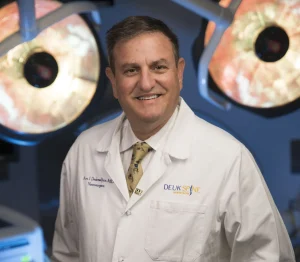

Dr. Ara J. Deukmedjian, MD
Board-Certified Neurosurgeon
Published: September 16, 2026
Medical Disclaimer: The contents of this article are provided for informational and educational purposes only. They are not intended to serve as medical advice, diagnosis, or recommended course of treatment. Always consult with a qualified healthcare professional before making decisions about your health.
Key Points
✓ 1 in 5 people undergoing knee replacements are unhappy with the results.
✓ Risks associated with knee replacement surgery include: infections, implant loosening, metal in blood stream, and change in leg length.
✓ 69% of those who undergo knee replacement surgery end up on chronic opioids.
✓ FDA approved ultra minimally invasive alternative called Deuk Plasma Rhizotomy® targets only your painful nerve fibers. No joint involvement.
✓ Outpatient surgery completed in 30 minutes, with a 4mm incision; no general anesthesia, no implant, no opioids.
✓ Average pain reduction of 85%, allowing most people to go back to normal activity the very next day.
✓ You can keep your knee, and you’re still a candidate for knee replacement at any point in time if you ever need it.
Each year, hundreds of thousands of people in America are advised to have a knee replacement procedure. This type of procedure is among the most common in the country’s orthopedic surgery field; yet, its prevalence keeps on increasing. On the other hand, such a procedure is not without risks, and it is a long process that requires rehabilitation and causes pain for many months. Dissatisfaction rates among patients undergoing a total knee replacement procedure are quite high, as research done by Acta Orthopaedica indicates. 1
For the millions living with chronic knee pain from arthritis, the idea of having your natural joint cut out and replaced with metal and plastic hardware is daunting, and for good reason. What if there were a way to eliminate the pain without eliminating the knee?
Introducing a new state-of-the-art, ultra minimally invasive, FDA-approved treatment for knee pain from arthritis of the knee joint. It is called Deuk Plasma Rhizotomy®, and it is changing the way chronic knee pain is treated.
What Is Deuk Plasma Rhizotomy®?
Deuk Plasma Rhizotomy® is a patented technique invented by neurosurgeon Dr. Ara Deukmedjian, where precise nerves which transmit pain from an arthritic knee joint are destroyed using a plasma wand. This plasma wand is passed through only one 4mm incision point to target these pain pathways, without the need for any surgical intervention on the joint itself.
Different from the conventional heat-based Radio Frequency Ablation procedure, the surgery offered by Deuk Joint utilizes energy that has lower temperatures to treat the targeted nerve tissues without affecting the surrounding joint structures. The natural anatomical structure and full motion of the knee joint are maintained. No implantation and no removal occur. The only thing done is to turn off the pain.
The Problem with Knee Replacement Surgery
Total knee replacement or total knee arthroplasty (TKA) consists of surgically removing the damaged joint surface and replacing it with a metal and plastic prosthesis through the use of cement. It entails an incision of six to ten inches in length, general anesthesia, hospital stay for one to four days and a prolonged recovery time from weeks to months. Many times, knee replacement for these individuals proves much harder than they had anticipated.
Patient satisfaction levels following knee replacement continue to be disappointingly high. Numerous registry studies done in Sweden, Canada and Australia have repeatedly shown that approximately four out of five patients are dissatisfied with the results of their operation. 1 The dissatisfied group comprises up to 25% of all patients who are less than 55 years old. 2 This is due to pain, unrealistic expectations and complications as outlined in the following sections.
Complications of Knee Replacement Most Patients Aren’t Told About
While orthopedic surgeons often present knee replacement as a routine, safe procedure, the peer-reviewed medical literature paints a more complex picture. There are several well-documented complications that every patient should understand before consenting to surgery.
Infection (Periprosthetic Joint Infection)
Infection is one of the most feared complications following knee replacement. Published data from Cleveland Clinic researchers reports that the rate of periprosthetic joint infection (PJI) after knee replacement in the United States falls around 2% or less for primary procedures. 3 That number may sound small, but given that hundreds of thousands of knee replacements are performed each year, it translates to tens of thousands of patients affected annually. More worryingly still, the Cleveland Clinic studies found the mortality rate of patients suffering from PJI after knee replacement to be 11.6% after about four years, a percentage that exceeds the five-year mortality rates of several common cancers. 3
In case of revision surgery. Meaning the need for another knee replacement to fix the problem with the previous knee prosthesis the infection rate is much higher, with statistics showing the range between 3% and 9%. 4 The treatment of PJI often requires many more operations, IV antibiotics, lengthy hospitalization, and sometimes even amputation of the affected limb.
Loosening of the Implant (Aseptic Loosening)
Aseptic loosening is the most frequent source of knee prosthesis complications leading to long-term failure. The phenomenon is defined by a gradual deterioration of the union between the prosthesis and the bone tissue it attaches to. Aseptic loosening is usually caused by the reaction of the body to small amounts of debris generated from the surfaces of the prosthesis. 5 This leads to the loosening, pain, and instability of the knee joint, which needs to be revised with surgery. The prosthesis is quite resistant but still not everlasting. The expected lifespan of the knee prosthesis is 15 to 20 years. 6
Metal Fragments from the Implant (Metallosis)
When the metal and plastic parts of an artificial knee rub against each other throughout years of wear, metal debris is produced. This kind of metal debris enters the soft tissues around the joint and even can get into the blood system. The term Metallosis refers to inflammation and bone destruction. 7
Growing research issue: According to an article published in Archives of Orthopedic and Trauma Surgery in 2025, one of the complications arising from cobalt poisoning through metal implant particles includes neurological impairment and dementia, which is not included in any national guidelines on monitoring of patients with metal joint prostheses. 8 Further, a study done on post-mortem brain tissue found that people who have joint replacements have high amounts of cobalt and titanium in their brain tissue, and both of these metals are linked to amyloid plaques. 9
Leg Length Variation
Leg length inequality after knee replacement is one complication that rarely gets communicated to patients before the operation, but there is scientific evidence to prove how common it really is. According to a study in International Orthopaedics, the leg length was found to have changed significantly for patients after a total knee replacement, and the mean leg length difference was found to be 5.4 mm, depending on the degree of preexisting deformities. 10 Further studies have also confirmed that people who suffered from leg length inequality after knee replacement were much more likely to fall, experience dislocation of the implant, mechanical loosening, fractures around the prosthesis, and even require revision surgery almost two and a half times sooner. 11
The Pain Medication Cycle: Why More Surgery Isn’t the Answer
For many patients with knee arthritis, the journey toward knee replacement begins with a familiar and frustrating loop: over-the-counter painkillers, then prescription anti-inflammatories, then cortisone injections, and eventually opioid pain medications. And when those fail, surgery is presented as the inevitable next step.
But the surgery itself frequently creates a new cycle of pain medication dependence. A large-scale analysis of Medicaid enrollees who underwent total knee replacement found that 69% of patients were classified as chronic opioid users in the months following surgery. 12 Orthopedic surgeons now rank as the third-highest prescribers of opioids among all medical specialties. 12 The proportion of patients who go on to experience chronic postsurgical pain after knee replacement has been estimated at up to 30%. 13
In the United Kingdom, there has been research that has shown an increased prescribing of opioids by a significant margin amongst patients who have undergone knee replacement surgery and who continue to suffer from chronic pain, reaching its peak within seven years after the procedure. This translates to the fact that a significant proportion of people who undergo knee replacements are dependent on the very medications the surgery seeks to eliminate.
And when the first knee replacement fails due to infection, loosening, or persistent pain. The proposed solution is often more surgery. Revision knee replacement is a more complex, more painful, and riskier operation than the original. Infection rates in revision procedures are roughly ten times higher than in primary replacements. 4
It is a cycle of escalation: pain medications, then surgery, then more pain medications, then more surgery. Deuk Plasma Rhizotomy® offers a way to step off that escalator entirely.
How Deuk Plasma Rhizotomy® Works
The Deuk Plasma Rhizotomy® procedure is built on a fundamentally different philosophy than knee replacement. Rather than removing the knee and substituting an artificial joint, it eliminates the pain at its neurological source.
Here is what the process looks like from a patient’s perspective:
Step 1: Free consultation and Diagnosis. The process begins with a no-cost review of your existing MRI report. Dr. Deukmedjian and his team identify the specific genicular nerves (the nerves that carry pain signals from the knee joint to the brain) and confirm whether you are a candidate. No office visit is required to begin.
Step 2: The 30-Minute Procedure. Under light twilight sedation. Not general anesthesia. Dr. Deukmedjian makes a single 4mm opening (smaller than a pencil eraser) and inserts the patented plasma wand. Using precision plasma energy, the targeted pain-carrying nerves are destroyed while the surrounding joint tissue and structure remain unharmed. The incision is closed with a single staple and covered with a Band-Aid.
Step 3: Home the Same Day. The patients leave Deuk joint the within an hour after the procedure. Recovery takes about one hour, and you go home the same day. There is no hospital stay. No general anesthesia. No opioid prescription. Most patients return to normal light activity the very next day.
No implant, no hardware, no opioids. Because our procedure destroys only the pain nerves and leaves the joint completely intact, there is nothing to loosen, no metal to shed debris, no foreign material to become infected, and no prescription narcotics required for recovery. Your natural knee stays exactly where it is.
Deuk Plasma Rhizotomy® vs. Knee Replacement: A Side-by-Side Comparison
The contrast between these two approaches is significant across nearly every dimension that matters to a patient. The table below highlights the key differences.
Who Is a Candidate for Deuk Plasma Rhizotomy®?
In the following instances, it is likely that you may qualify for Deuk Plasma Rhizotomy. When a doctor recommends knee replacement surgery but you wish to explore other alternatives before going getting the operation. When you suffer from chronic knee pain caused by arthritis or degenerative joint disease that has not gone away from using: medications, injections, and physical therapy. And when you wish to avoid the hardware, the hospitalization period, and the long recovery process associated with the surgery. Or when you have undergone knee replacement surgery that did not treat the pain.

The quickest means of determining whether or not our minimally invasive treatment is the best for you is a free MRI analysis. If our rhizotomy does not suit you, then you will still be a full candidate for knee replacement surgery.
The Bottom Line
Knee replacement is a high risk surgery with risks such as infection, implant failure, metal debris in the body and blood stream, discrepancy in leg length, chronic pain after the surgery, and prolonged use of opioids for pain management. However, for many people, those risks can be avoided.
The Deuk Plasma Rhizotomy® is a completely new solution that does not address the knee itself, but the pain. The surgery takes only 30 minutes, done on an outpatient basis, via a 4mm incision using twilight sedation. The process does not include an implant, no hospitalization, no general anesthesia, and no use of opioids. On average, the pain decreases by 85%.
At Deuk Joint, the emphasis is not on joint replacement but on saving your joint. This process was created by Dr. Ara Deukmedjian, a highly esteemed neurosurgeon with more than 20 years of experience, as he felt that people should have a better solution to joint replacement than just removing their natural joint. If you or someone you know suffers from chronic knee pain and has been told that the only cure is joint replacement, then perhaps there is an alternative.
Keep Your Knee.
Lose the Pain.
Deuk Plasma Rhizotomy eliminates knee arthritis pain at the nerve — not the joint. A 30-minute outpatient procedure with no implant, no general anesthesia, and no opioids.
FAQ
What is Deuk Plasma Rhizotomy?
Answer
Deuk Plasma Rhizotomy is a patented, minimally-invasive day surgery that utilizes precise plasma energy for ablation of the particular nerve roots that carry pain impulses from the arthritis-afflicted knee joint. It was invented by neurosurgeon Dr. Ara Deukmedjian, and involves treatment of the underlying cause of the pain without replacement of the knee. The whole surgery process involves one 4 mm incision done under twilight anesthesia within 30 minutes.
Is Deuk Plasma Rhizotomy FDA approved?
Answer
Yes. Deuk Plasma Rhizotomy uses FDA-approved plasma technology to ablate the pain-carrying nerves around the knee joint. The procedure is performed using a patented plasma wand that has been cleared for clinical use.
How long does the pain relief last?
Answer
Results are typically permanent. In some cases, patients may experience soreness in the surrounding muscles (bursitis or tendonitis) as they return to higher levels of activity, which can feel similar to the original knee pain but originates from a different source. Occasionally, the procedure may be repeated if needed, or other treatments can address muscle-related discomfort.
Will I be under general anesthesia?
Answer
No. Deuk Plasma Rhizotomy is performed under light twilight sedation, not general anesthesia. This is one of the reasons recovery is so fast. You are relaxed and comfortable during the procedure but are not put fully under.
How does Deuk Plasma Rhizotomy differ from radiofrequency ablation (RFA)?
Answer
Traditional radiofrequency ablation uses heat to damage nerve tissue, which can affect a broader area and may cause collateral damage to surrounding structures. Deuk Plasma Rhizotomy uses plasma energy at a lower temperature, allowing for more precise targeting of the specific pain-carrying nerves while preserving the joint and its surrounding tissue.
Can I still get a knee replacement later if I need one?
Answer
Absolutely. Because Deuk Plasma Rhizotomy does not remove, alter, or implant anything in your joint, you remain a full candidate for knee replacement if it becomes necessary in the future. Trying a less invasive option first carries no downside.
What if my knee replacement already failed. Can I still be treated?
Answer
Often, yes. Because Deuk Plasma Rhizotomy targets the pain nerves rather than the joint structure or implant, many patients who have had a failed or painful knee replacement are still candidates. A free MRI review can confirm whether the procedure is right for your specific situation.
How do I find out if I am a candidate?
Answer
The simplest first step is a free MRI review. Send your recent MRI or CT report to the team at Deuk Joint, and Dr. Deukmedjian will personally review it. At no cost to determine whether Deuk Plasma Rhizotomy can relieve your knee pain. You can also call 321-255-6670 to speak with the care team directly.
Sources
View Sources
- Verhaar, J. (2020). Patient satisfaction after total knee replacement — still a challenge. Acta Orthopaedica, 91(3), 241–242. PMC8023893
- Scott, C.E.H. et al. (2016). Predicting dissatisfaction following total knee replacement in patients under 55. Bone Joint J, 98-B, 1625–34. View source
- Ramos, N. et al. (2026). Periprosthetic joint infection mortality after knee replacement. Cleveland Clinic Consult QD. View source
- Babkin, Y. et al. Revision TKA infection: incidence and predictors. Clin Orthop Relat Res. PMC2895829
- Dalury, D. et al. Current concepts in knee replacement: complications. AJR. View source
- Plancher Orthopaedics. Understanding knee replacement failure. View source
- Jayasekera, N. et al. (2015). Metallosis after TKR. Case Reports in Orthopedics. PMC4387939
- Beshr, M. et al. (2025). Metal-on-metal arthroplasty, cobalt toxicity, and cognitive impairment: a systematic review. Arch Orthop Trauma Surg. PubMed 40244464
- Brain tissue metal concentrations and AD neuropathology in TJA patients (2025). PMC13064742
- Farouk, O. et al. (2023). Leg length difference after TKR. International Orthopaedics. PMC10673729
- Ng, M.K. et al. Leg length discrepancy and TKA complications. Arch Orthop Trauma Surg. PMC10790485
- Diiorio, M.L. et al. (2022). Risk factors and trajectories of opioid use following TKR. Knee Surg Relat Res. PMC8981598
- Rheumatology Advisor. Pain management after TKA: limiting opioid utilization (2024). View source
- Pinedo-Villanueva, R. et al. (2022). Primary care consultations and pain prescriptions: chronic pain after TKR. PMC9172077