

Dr. Ara J. Deukmedjian, MD
Board Certified Neurosurgeon
Published: October 14, 2026
Medical Disclaimer: This article is for informational purposes only and is not a substitute for professional medical advice, diagnosis, or treatment. Always consult a licensed orthopedic physician for persistent hip pain.
Key Points
✓ Hip pain affects nearly 25% of people over 60 years of age in America. Thus making it one of the most common joint complaints in the United States. 1
✓ The site of pain gives an indication as to where the problem lies inner-hip or groin pain indicates a joint-related issue while outer-hip or buttock pain suggests soft tissue injuries. 2
✓ Osteoarthritis remains the most common cause of hip pain in adult patients over 50 years of age and affects almost 1 in 4 people. 3
✓ Trochanteric bursitis often causes sleep disturbances as over 70% of patients who suffer from lateral hip pain have nighttime symptoms. 6
✓ All hip pain is not necessarily related to hip problems. Conditions such as sciatica, lumbar disc injury and piriformis syndrome could cause pain in the hips. 2
✓ Hip fractures constitute a medical emergency, with over 300,000 hospitalizations annually in America among individuals over the age of 65 years. 1
✓ The Deuk Plasma Rhizotomy® offers a minimally invasive alternative for patients dealing with nerve pain.
A Quick Anatomy Refresher
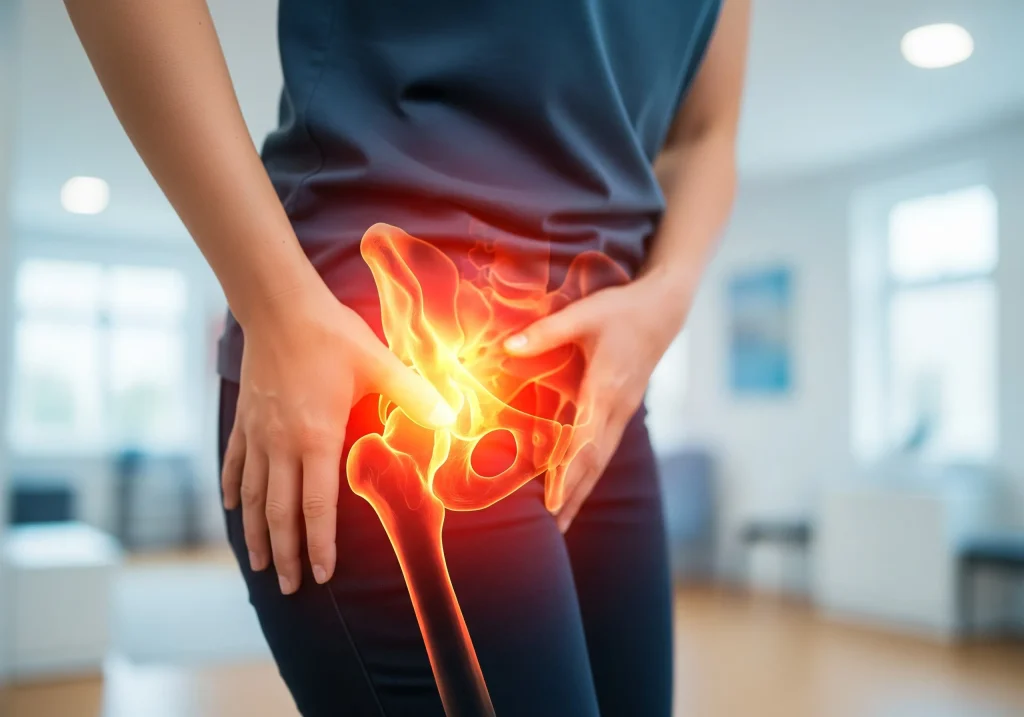
Your hip is a ball-and-socket joint the rounded top of your thigh bone (the femoral head) sits inside a cup-shaped portion of your pelvis called the acetabulum. Surrounding all of that is a web of cartilage, ligaments, tendons, muscles, and small fluid-filled sacs called bursae that keep everything gliding smoothly.
Because so many structures sit so close together, pinpointing the source of pain can get complicated. The Cleveland Clinic puts it this way: pain felt in the groin or inside of the hip usually comes from the joint itself, whereas pain along the outer thigh, buttock, or upper leg tends to point toward surrounding soft tissue. 2 It’s a simple rule of thumb and often the first clue your doctor uses during an exam.
The Usual Suspects Behind Hip Pain
Osteoarthritis
If you’re over 50 and your hip hurts, osteoarthritis is statistically the most likely reason. It’s a slow, grinding process. The cartilage that cushions your joint wears down over the years, leaving bone to rub against bone. 3
Classic signs include:
- A deep ache in the groin or front of the thigh
- Stiffness in the morning that loosens up with a bit of movement
- Trouble putting on socks or getting out of a low chair
- A grinding or clicking sensation when you walk
The American Academy of Orthopedic Surgeons estimates that about one in four people will develop hip osteoarthritis during their lifetime. 3 It’s that common.
Trochanteric Bursitis
Ever lie down for the night and feel a burning pain shoot through the outer side of your hip? That’s a classic bursitis presentation. Bursae are little cushions designed to prevent friction, but when they get inflamed, they turn into a source of pain instead of relief. 2
Side-sleepers often get the worst of it. The weight of your own body compresses the inflamed sac, and sleep becomes a nightly battle. 6
Tendinitis
Overuse is the hallmark here. Runners who bump up their mileage too fast, cyclists logging big weekend miles, or anyone starting a new fitness routine can irritate the tendons around the hip. The pain usually shows up gradually and worsens with activity. 7
Labral Tears
The labrum is a ring of cartilage that lines the hip socket, giving the joint extra stability and cushion. Tears can happen from a one-time injury, repetitive motion, or structural quirks like femoroacetabular impingement (FAI). 4
What does it feel like? Think catching, clicking, or locking. Along with groin discomfort that gets worse after a long car ride or an intense workout. 4
Hip Fractures
For older adults particularly those with osteoporosis. A fall can be devastating. The CDC reports that more than 300,000 Americans 65 and older are hospitalized for hip fractures each year. 1 This isn’t something to tough out at home; it’s an emergency and almost always requires surgery.
Muscle Strains
Pulled hip flexors, groin strains, and glute tweaks are everyday injuries for athletes and weekend warriors alike. Pain tends to be sharp when the injury happens, then settles into a dull, lingering ache during recovery. 7
Sciatica and Lower-Back Issues
Here’s the twist a lot of patients don’t expect. Sometimes the hip isn’t the problem at all. A pinched nerve in your lumbar spine can send pain shooting through the buttock and down the leg in a pattern that feels exactly like a hip issue. 2 Herniated discs and spinal stenosis are common culprits.
Why Does Hip Pain Travel Down the Leg at Night?
This question gets typed into Google thousands of times a month, and the answer isn’t one thing. It’s several possibilities worth knowing about.
Sciatica often flares after dark. When you lie flat, pressure on the spinal nerves actually increases, which is why so many people say their pain is worse at night than during the day. 2
Bursitis does something similar. Lying on the sore side crushes the inflamed bursa, and radiating pain down the outer thigh follows. 6
Osteoarthritis has its own nighttime pattern. During the day, you move around and distract yourself. At night, there’s no distraction, just the ache. 3
Piriformis syndrome rounds out the list. When this small muscle in the buttock tightens up, it can press against the sciatic nerve and mimic sciatica almost perfectly. 7
One review in The Journal of Orthopedic & Sports Physical Therapy found that sleep disruption affects more than 70% of patients with lateral hip pain. 6 If you’re losing sleep over this, you’re far from alone and it’s a strong signal to see someone.
What About Hip Pain When You Walk?
Mechanical pain is the kind that gets worse with each step. Usually traces back to one of these:
- Osteoarthritis. Weight-bearing on a worn-down joint hurts, plain and simple. 3
- Hip impingement (FAI). Bones bump against each other in ways they weren’t designed to. 4
- Labral tears. The femoral head catches on torn cartilage mid-stride. 4
- Snapping hip syndrome. Tendons slide over bony landmarks, sometimes with an audible pop. 2
- Stress fractures. Tiny cracks in the femoral neck or pelvis. Common in runners and in older adults with thinning bones. 1
Here’s a useful rule: if walking makes you limp or shortens the distance you can comfortably cover, don’t wait it out. Get it looked at.
Who’s Most at Risk?

Certain factors stack the deck. The National Institute of Arthritis and Musculoskeletal and Skin Diseases flags these as the big ones: 5
- Being 50 or older
- Carrying extra body weight
- Previous hip injuries
- High-impact sports like running or basketball
- Family history of arthritis
- Jobs that involve long hours standing or heavy lifting
- Osteoporosis or low bone density
- Hormonal shifts after menopause
Having one or two risk factors doesn’t guarantee you’ll develop hip problems but it does mean paying closer attention when symptoms show up.
When Should You Stop Waiting and Call a Doctor?
A little soreness after yard work? Rest, ice, and ibuprofen can usually handle that. But some symptoms shouldn’t be ignored:
- Hip pain after a fall or any kind of trauma
- Not being able to put weight on the affected leg
- Visible deformity in the hip or leg
- Sudden swelling, warmth, or redness around the joint
- Fever paired with hip pain (this can signal infection)
- Pain that just won’t quit after two weeks of rest
For chronic or worsening pain, seeing a board-certified orthopedic specialist is the smart move. A proper diagnosis usually involves a physical exam, X-rays, MRI, and sometimes a diagnostic injection to confirm the source.
How Is Hip Pain Treated?
The playbook almost always starts conservatively:
- Physical therapy to build up the muscles that support the joint
- NSAIDs to control inflammation and pain
- Injections corticosteroids for inflammation, or regenerative options like PRP and stem cell therapy
- Weight management to lighten the load on the joint
- Activity changes and bracing to protect the hip while it heals
- Treat your hip pain at Deuk Joint with the Deuk Plasma Rhizotomy®
Surgery enters the conversation when conservative care has run its course and quality of life is taking a real hit. Options range from minimally invasive hip arthroscopy to resurfacing and, in more advanced cases, total hip replacement.
The Bottom Line
Hip pain has a long list of possible causes, and no single treatment fits them all. The right approach depends entirely on what’s driving your symptoms. If pain is messing with your sleep, your daily routine, or how far you can walk, don’t push through for months hoping it’ll fade. Early diagnosis protects the joint from further damage and gives you the widest range of treatment options, many of them non-surgical.
Find out what’s
really causing it.
Hip pain has many possible sources — arthritis, bursitis, a labral tear, or a problem in your lower back entirely. Send us your MRI and Dr. Deukmedjian will personally review it, free of charge, to pinpoint what’s driving your pain and whether Deuk Plasma Rhizotomy® can relieve it.
FAQ
Why does my hip hurt when I’m just sitting or lying down?
Answer
Pain at rest is often a sign that something more significant is going on advanced arthritis, bursitis, or inflammatory conditions like rheumatoid arthritis. It can also point to avascular necrosis, a condition where blood supply to the femoral head is interrupted, and that one needs prompt evaluation.
Is hip pain different for women?
Answer
Yes, in several ways. Women tend to get bursitis, osteoarthritis, and stress fractures at higher rates thanks to a wider pelvis, hormonal fluctuations around menopause, and greater susceptibility to osteoporosis.
Could my hip pain be something serious?
Answer
Most of the time, it’s a musculoskeletal issue. But occasionally, persistent pain can signal infection (septic arthritis), a bone tumor, or avascular necrosis. Unexplained or worsening symptoms deserve a workup.
I had a hip replacement. Why does my knee hurt now?
Answer
This surprises a lot of patients. Changes to how you walk, slight differences in leg length, or arthritis that was already brewing in the knee can all surface after hip surgery. Physical therapy usually sorts it out.
My hip and leg hurt on just one side. What gives?
Answer
One-sided hip and leg pain most often points to sciatica, osteoarthritis, trochanteric bursitis, or a labral tear. A targeted exam plus imaging will tell your doctor what they’re dealing with.
Will hip pain just go away on its own?
Answer
Sometimes, yes. Minor strains and overuse tweaks often resolve within a few days of rest and ice. But anything that drags on for the past two weeks or keeps getting worse. It needs professional eyes on it.
Should I keep walking if my hip hurts?
Answer
Generally speaking, gentle walking is good for arthritic hips. It keeps the joint moving and strengthens the muscles around it. That said, if walking consistently makes things worse, back off and get evaluated.
Sources
View Sources
- Centers for Disease Control and Prevention (CDC). Arthritis Related Statistics. https://www.cdc.gov/arthritis/data_statistics/
- Cleveland Clinic. Hip Pain: Causes and Treatment. https://my.clevelandclinic.org/health/symptoms/21118-hip-pain
- American Academy of Orthopedic Surgeons (AAOS). Osteoarthritis of the Hip. https://orthoinfo.aaos.org/en/diseases–conditions/osteoarthritis-of-the-hip/
- Johns Hopkins Medicine. Hip Labral Tear. https://www.hopkinsmedicine.org/health/conditions-and-diseases/hip-labral-tear
- National Institute of Arthritis and Musculoskeletal and Skin Diseases (NIAMS). Osteoarthritis. https://www.niams.nih.gov/health-topics/osteoarthritis
- Journal of Orthopedic & Sports Physical Therapy (JOSPT). Greater Trochanteric Pain Syndrome: A Review. 2023.
- Mayo Clinic. Hip Pain – Symptoms and Causes. https://www.mayoclinic.org/symptoms/hip-pain/basics/causes/sym-20050684